
Make Your Company Party Unforgettable with a New Kind of Prize Drawing
It was Friday evening, and Tanaka, the party organizer, sat at her desk with a growing headache. She'd been tasked with running the prize drawing at next week's year-end party, but every option had its drawbacks: paper lots invited suspicion of rigging, roulette wheels lacked transparency, and remote participants would be left out entirely. Every method had its issues.
This article introduces a participatory drawing method that solves these common organizer challenges.

The Problems with Traditional Drawing Methods
See a detailed comparison of various lottery methods here
Paper lotteries and spinning drums have one fundamental problem: remote participants cannot join in. Disputes about who draws first are also common, and preparation takes considerable effort.
Roulette wheels and lottery software are operated solely by the organizer, making it impossible for participants to verify whether the results are truly random. Passive drawings also struggle to create a sense of unity among the group.
Excel random number functions are complicated to operate, hard to read on a shared screen, and come with the lingering doubt that the formulas could be tampered with.
What Makes Amida-san Different
Everyone Participates with Full Transparency
All participants add rungs to build the amidakuji together. Since no one can manipulate the outcome, there's a genuine sense of "we built this together." Both remote and on-site participants can join on equal footing.
Just Share a URL -- Setup Takes 5 Minutes
Create an event, share the URL with participants, and start the drawing once everyone has joined. That's it -- three simple steps. No need to rent a spinning drum or prepare paper lots.
Scales to Large Groups
Amida-san handles large numbers of participants, making it suitable for organization-wide events without any issues.
How It Works in Practice
Preparation (One Day Before)
The organizer creates an event on Amida-san and sets up the prize names. For example: "1st Place: $20 Gift Card," "2nd Place: Premium Sweets Set," "3rd Place: Coffee Gift." Then share the event URL with all participants.
On the Day
Ten minutes before the drawing, announce: "Please open the URL on your phone and enter your name." Five minutes before, confirm that everyone has joined and send individual reminders to anyone who hasn't.
When it's time for the drawing, participants take turns adding rungs one by one. Once everyone has added theirs, press the start button to reveal the results. Using the Amida 3D option, balls roll dynamically through the course, adding excitement to the venue. Results appear on screen for everyone to see at the same time.
Beyond Amida 3D, the Pro plan offers tools built for running organization-wide events -- such as lifting participant limits and re-drawing results -- and you can see them all in every Organizer Plan (Pro) feature, explained.
Brand the Participation Page in Your Company Colors (Pro)
Try Amida-san Free Now
With the Organizer Plan (Pro) event decoration feature, you can match the draw page to your company's brand identity.
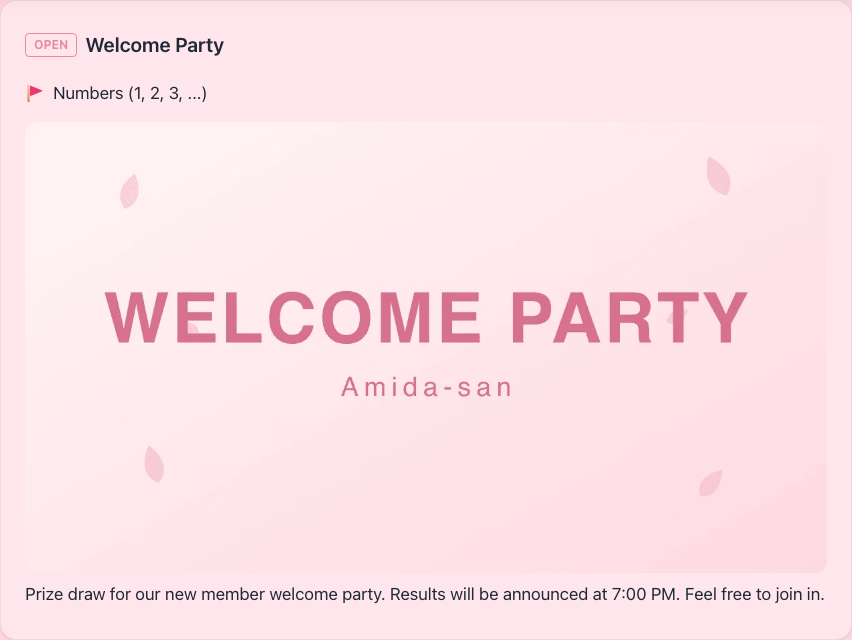
For example, set your corporate color as the theme and place the company logo or year-end-party key visual in the header. Participants who open the link immediately understand "this is the official internal event page." Include the prize list, start time, and the host's name in the description so the MC has less to announce on the day. When several teams run different ghost-leg draws on the same evening, themes and images make each event distinguishable at a glance, preventing guests from clicking the wrong link.
For anniversary parties that include external partners or kickoff meetings where brand consistency matters, even the participation page can convey "this is a serious, well-run company event," which boosts trust in the draw itself. See how to decorate your event page for details.
Other Occasions Where Amida-san Shines
Beyond year-end and New Year parties, Amida-san works in a wide range of situations: anniversary celebrations and special awards at ceremonies, team assignments and project leader selection at kickoff meetings, group activity assignments, choosing a restaurant or an organizer for after-parties, webinar participant giveaways, and more.
Frequently Asked Questions
What if the number of prizes doesn't match the number of participants?
If you have 50 participants and 5 prizes, you can set it so that the top 5 win prizes.
What if more participants join at the last minute?
New participants can be added at any time before the drawing starts.
Can results be reviewed afterward?
The event URL can also be used to check results later. Taking a screenshot is recommended for extra peace of mind.
Summary
Amida-san is a drawing tool where everyone participates, transparency is built in, and setup is as simple as sharing a URL. Both remote and on-site participants can join equally, and the Amida 3D feature adds excitement to any event.
This year, make your company party memorable with a fair drawing that everyone can trust.
Try Amida-san Now!
Experience fair and transparent drawing with our simple and easy-to-use online ladder lottery tool.
Try it Now