
2026 Year-End Party Prize Drawing Complete Guide: Corporate Events and Celebrations
When your year-end party mixes in-office and remote attendees in a hybrid format, how do you run a prize drawing that feels fair to everyone? This is a challenge many event organizers face.
This article covers drawing methods you can use for year-end parties, New Year celebrations, and company-wide meetings, along with tools that balance excitement, transparency, and fairness. From prize selection to day-of logistics, budget-based configurations, and common troubleshooting, this guide compiles everything an event organizer needs.

Three Trends in Year-End Corporate Events
Trend 1: Hybrid Events Are the Norm
Many companies now hold year-end events combining in-office and remote participation. Fully in-person events have become the minority, and fully online events are also declining.
The biggest challenge for organizers is creating a program that is equally enjoyable for people at the venue and those joining remotely. For prize drawings in particular, it is crucial to ensure remote participants do not end up just watching.
Trend 2: Rising Prize Budgets
Prize values are increasing, and it is not unusual for companies to spend $500 to $1,000 on a first-place prize. For events with around 100 attendees, total prize budgets of $3,000 to $5,000 are common.
Behind this trend is a corporate stance of investing in annual events as a way to maintain employee morale. As prize values go up, participants pay closer attention to whether the process is truly fair, making transparency and fairness increasingly important.
Trend 3: Demand for 3D Effects and Social Media Appeal
Interest is growing in interactive presentations, such as displaying drawing results in 3D or creating shareable video content for social media. With younger employees entering the workforce, more companies are incorporating social media awareness into their corporate branding.
We are in an era where a "mere drawing" is not enough -- event experiences that everyone can enjoy are expected. Balancing excitement with fairness is where the organizer's skill truly shines.
Five Prize Drawing Methods Compared
Method 1: Traditional Lottery Machine (Garapon)
Best suited for fully in-person venues with 50 or fewer attendees.
Pros:
- Visually fun with an analog warmth
- Creates a sense of immediacy when done in front of participants
Cons:
- Remote participants cannot take part
- Requires setup and cleanup time
- Time-consuming for large groups since each person draws individually
- Suspicions of tampering can arise
With hybrid events now the norm, a lottery machine that only venue attendees can use has become a lower priority option.
Method 2: Bingo Game
Best when you want to emphasize entertainment and have time to build excitement.
Pros:
- Everyone can participate with high game-like engagement
- Easy to build excitement and can serve as the main event
- Works well when you want to distribute prizes to everyone
Cons:
- Takes 30 minutes to an hour
- Requires a large number of prizes (nearly one per person)
- Difficult to manage with mixed online and offline participants
- Number calling and verification is labor-intensive
Effective when time is plentiful and you want to give everyone a prize, but not ideal for events where you need the drawing done quickly.
Method 3: Excel Random Numbers on a Projector
Works for small groups of 30 or fewer at minimal cost.
Pros:
- Completely free with no preparation needed
- Can start immediately with an office projector
Cons:
- Creates suspicion that "Excel formulas can be manipulated"
- Remote participants can only watch the screen
- Difficult to prove transparency (operated on the organizer's PC)
- Weak in terms of visual appeal and excitement
While convenient, this method struggles to earn participant confidence when high-value prizes are involved.
Method 4: Online Roulette Websites
Handy for small events with 20 or fewer people.
Pros:
- Visually appealing with many free options available
- Virtually no setup required
Cons:
- Lacks transparency since only the organizer operates it
- Remote participants can only watch via screen share
- Time-consuming for large groups since each person takes a turn
- Ad displays can be distracting
Useful for casual department gatherings or small group parties, but not suitable for company-wide events.
Method 5: Amida-san (Participatory Digital Ghost Leg)
Ideal for hybrid events and large groups where transparency and fairness are priorities.
Pros:
- In-office and remote participants are completely equal
- Everyone can participate by adding rungs to the drawing
- Results can be verified later by saving the URL
- Supports up to 299 participants
- 3D display available for added flair (paid option, $5.99)
- Free basic use with no registration required
Cons:
- Requires a brief explanation of how Ghost Leg works
- 3D display is a paid feature ($5.99)
Each method has its ideal use case. Choose based on event size, format, prize value, and participant demographics.
Practical Step-by-Step Guide for Hybrid Events
Here we use an IT company (approximately 300 employees) hosting a hybrid year-end party as an example to walk through a specific drawing procedure using Amida-san.
Event Parameters
- Venue attendees: approximately 180 (headquarters and branch offices)
- Remote attendees: approximately 120 (home offices and regional locations)
- Prizes: 20 items total, from a first-place travel voucher to twentieth-place food items
Problems with Traditional Methods
When a traditional lottery machine was used at the venue, these issues commonly arose:
- Remote participants felt it was unfair that only venue attendees could participate
- It was hard to follow what was happening through a screen, leading some to stop watching
- Drawing one person at a time took nearly an hour, cutting into after-party time
- Suspicions of rigging occasionally surfaced
Remote participant dropout and dissatisfaction affect next year's participation rates. For organizers, spending most of the limited event time on the drawing is also frustrating.
Step-by-Step Process Using Amida-san
Step 1: Advance Preparation (One Week Before, 30 Minutes)
- The organizer accesses Amida-san and registers 20 prizes and information for 300 participants
- Shares the generated drawing URL with all employees via Slack and email
- Announces the deadline for adding rungs: "6:00 PM on the day of the party"
- Includes a brief explanation of how to participate (just open the URL on your phone and add a rung)
Step 2: Party Day - Opening (6:00 PM)
Proceed with the standard opening remarks and toast. At this point, mentioning "The prize drawing starts at 6:30 PM -- please have your phones ready" builds anticipation.
Step 3: Drawing Time (6:30 PM, Approximately 10 Minutes)
- The MC asks everyone to open the URL on their phones
- Both venue and remote attendees access it simultaneously on their phones
- "Everyone, please add one rung" is announced
- Rungs appear in real-time on the large screen and Zoom screen share
- Adding rungs is closed when the deadline arrives
At this stage, most participants add rungs. Participation rates tend to be high since there is a chance to win a prize.
Step 4: Results Announcement (6:35 PM, Approximately 5 Minutes)
- Turn on 3D display for the results announcement ($5.99 paid option)
- The 3D Ghost Leg screen appears, showing an animation of balls rolling down vertical lines and branching at rungs
- Announce winners starting from first place
- Post the results URL to Slack so anyone can check later
Step 5: Drawing Complete (6:40 PM)
The entire drawing takes about 15 minutes. Remaining time is available for food, drinks, and socializing.
Benefits of This Approach
Shorter drawing time: What used to take an hour with a lottery machine is completed in about 15 minutes, freeing up time for socializing and other content.
Remote participant engagement: Through the act of adding rungs, remote participants feel they are personally involved in the drawing. More people stay tuned until the end.
Increased confidence: Since everyone is involved in the process and results can be verified via the URL afterward, suspicions of unfairness do not arise.
Social media sharing: The 3D display creates visually striking content that employees sometimes voluntarily share on social media, which is a plus for corporate branding.
Use Cases by Scenario
Scenario 1: Year-End Party (Hybrid)
Everyone can participate from their phones in a mixed in-office and remote environment. The 3D display adds excitement to the event.
Recommended prize structure:
- 1st place: $1,000 travel voucher
- 2nd-3rd place: $500 gift cards
- 4th-20th place: Electronics, food items, experience gifts
Prizes that people are genuinely happy to receive, matched to participants' age range and interests, boost satisfaction.
Scenario 2: New Year Kickoff Meeting
Can also be used to randomly determine department presentation order. This prevents the pattern of "the same department always goes first" or "always goes last," creating an arrangement everyone can accept.
Beyond presentation order, it also helps fairly distribute the pressure of announcing New Year goals. When the order is determined by Ghost Leg, complaints like "why are we going first?" are less likely.
Scenario 3: Company-Wide Meeting (Quarterly/Annual)
Handles large groups (up to 299 people) and allows all executives and employees to participate. The ability to save and verify results via URL provides reassurance from a corporate audit perspective.
Use cases:
- MVP or special award drawings
- Company-wide prize drawings
- Inter-department prize allocation
Since company meetings often require accountability for transparency, the ability to save and share results as a URL is a significant advantage.
Scenario 4: Christmas Party
Simple enough for children to operate on a phone at family events. The visually appealing 3D display is enjoyable for the whole family.
Recommended prizes:
- Family travel vouchers or theme park tickets
- Toys and games
- Assorted snack boxes
For family events, "experience-based" prizes that everyone around the winner can enjoy tend to be well-received.
Scenario 5: Online New Year Party (Fully Remote)
Everyone accesses via URL, and results are announced through Zoom screen share. In a fully remote setting, the strength of Ghost Leg -- where everyone participates under identical conditions -- truly shines.
Recommended prizes:
- Digital gift cards (Amazon, etc.)
- Food delivery or gourmet gift sets
- Online experiences (cooking classes, yoga, workshops, etc.)
For fully remote events, digitally delivered prizes are more convenient than physical ones since no shipping is needed.
Scenario 6: Department-Level Year-End Party (30-50 People)
Fair even for small groups, with 5 minutes of preparation and no cost. The free version is enjoyable enough, letting you focus department budgets on prizes.
Recommended prizes:
- Restaurant gift cards ($25-$50)
- Wine, spirits, or sweets
- Experience gifts (massage, cafe tickets, etc.)
Scenario 7: Anniversary Events
The 3D display provides an impressive presentation fitting for a special event. Records are preserved as URLs, serving as event documentation.
Recommended prizes:
- High-value prizes ($2,000-$5,000 travel vouchers, etc.)
- Commemorative items (company-branded merchandise)
- Special paid time off
Anniversary events are milestones that remain in employees' memories. Investing in drawing presentation elevates the overall impression of the event.
Dress Up the Participation Page in Seasonal Style (Pro)
Try Amida-san Free Now
The Organizer Plan (Pro) event decoration feature lets you carry the seasonal feel of a year-end party straight into the participation page.
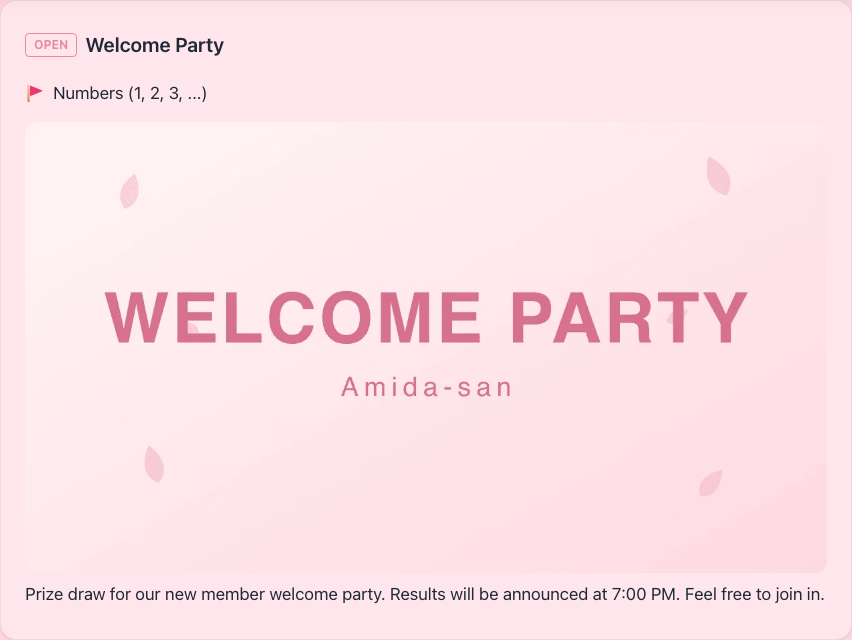
For a year-end kickoff, pick a winter or snow-themed color palette, put the company logo or a "Acme Corp. Year-End Party 2025" key visual in the header, and use the description to spell out: "Draw begins at 7:00 PM. Please add two horizontal lines before then." That alone removes most of the MC's explanation on the day.
When multiple divisions run year-end, New Year's, and anniversary draws in the same week, themes and images let participants tell them apart at a glance, preventing the classic "wrong link" mishap. Even when external partners are invited to a large event, the participation page itself looks like an official corporate draw — a fitting match for the value of the prizes on the line.
See how to decorate your event page for details.
Prize Selection Tips by Budget
Prize structure should balance grabbing attention with a high-value first-place prize while increasing the number of mid-tier winners so that participants feel "I have a chance too."
Budget: $500 (50 Attendees)
| Rank | Prize | Value |
|---|---|---|
| 1st | Gift card | $100 |
| 2nd-5th | Gift vouchers | $50 each |
| 6th-10th | Snacks and sundries | $20 each |
Even with a small budget, having 10 winners maintains participant anticipation.
Budget: $2,000 (100 Attendees)
| Rank | Prize | Value |
|---|---|---|
| 1st | Travel voucher | $500 |
| 2nd-3rd | Gift cards | $300 each |
| 4th-10th | Electronics | $100 each |
| 11th-20th | Food items | $30 each |
With 20 winners, one in five people wins, making it easy to sustain excitement.
Budget: $5,000 (200 Attendees)
| Rank | Prize | Value |
|---|---|---|
| 1st | Travel voucher | $1,000 |
| 2nd-3rd | Gift cards | $500 each |
| 4th-10th | Electronics | $300 each |
| 11th-30th | Gifts | $50 each |
With 30 winners, about one in seven wins. A well-balanced structure between top-tier luxury and winner count.
Budget: $10,000 (300 Attendees)
| Rank | Prize | Value |
|---|---|---|
| 1st | Travel voucher | $2,000 |
| 2nd-5th | Gift cards | $1,000 each |
| 6th-20th | Electronics | $500 each |
| 21st-50th | Gifts | $100 each |
With 50 winners, about one in six wins. Ensures sufficient winning probability even at the 300-person scale.
Key Points for Prize Selection
- Cash and gift cards are universally appreciated regardless of age or interests
- Experience-based gifts (spa treatments, hot springs, sports activities, cooking classes) are trending
- Digital gifts (Amazon, shopping points, subscriptions) require no shipping for remote participants
- Eco-friendly electronics and organic foods are gaining attention as sustainable options
- Adjust prizes to match the age range and demographics of participants
Organizer's Preparation Checklist
Here is a summary of preparation items for smooth drawing execution.
One Week Before
- Complete prize ordering and purchasing
- Create the event on Amida-san and register prizes and participants
- Share the drawing URL with all employees (Slack, email, company portal, etc.)
- Announce the deadline for adding rungs
- Create a simple instruction document for participation (screenshots help)
Day Before
- Verify prize delivery and quantities
- Conduct a day-of rehearsal (confirm MC coordination)
- Test Zoom screen share and projector display
- Send a reminder to remote participants to test their connection
Day Of
- Send a deadline reminder for adding rungs via Slack and email
- Final check of venue large screen and Zoom screen share
- Conduct the drawing
- Post the results URL to Slack
- Arrange prize distribution and shipping (ship remote participants' prizes the next business day)
Common Challenges and Solutions
Remote Participants Not Adding Rungs
Set a deadline in advance and send multiple reminders. If some people have not participated by the deadline, establish a pre-announced rule that the organizer will add rungs on their behalf.
In practice, most participants voluntarily participate since there is a chance to win prizes.
A Winner Declines Their Prize
Establish re-draw rules in advance. Specifically:
- Declines are accepted only on the day of the event (no later declines)
- If someone declines, a re-draw is conducted on the spot
- Or, runners-up move up in rank
Announce which rule you are following before the event starts to prevent confusion.
Unstable Network During the Drawing
Check the venue's Wi-Fi in advance and inform participants they can also access via mobile data. Amida-san loads lightly on smartphone browsers, so standard mobile connections work without issues.
Participants Unfamiliar with Ghost Leg
In companies with international employees, some may not be familiar with Ghost Leg. Include a brief explanation in advance communications: "Start at the top of a vertical line, go downward, and when you hit a horizontal rung, follow it to another line." Amida-san supports four languages (Japanese, English, Chinese, Korean), so language is not a concern.
Frequently Asked Questions
When Is the Best Time for the Prize Drawing?
The first half of the event, about 30-40 minutes after starting, is recommended. At this point, everyone has arrived, latecomers have minimal impact, and no one has left early yet.
Example timeline (2-hour year-end party):
- 6:00 PM: Opening and toast
- 6:30 PM: Prize drawing (15 minutes)
- 6:45 PM: Dinner and socializing
- 7:30 PM: After-party announcements
- 8:00 PM: Close
Placing the drawing in the middle of dinner reduces attention, so doing it in the first half is more effective.
Is the 3D Display Required? Can the Free Version Create Excitement?
The free 2D display offers the same fairness and transparency and is perfectly enjoyable. The free version is sufficient for department-level parties of 100 or fewer.
The 3D display ($5.99) is suited for when you want animation effects or social media-worthy content. For company-wide events with 300 attendees or events with large prize budgets, it is worth considering as an investment in presentation. Compared to the prize budget, $5.99 is a negligible cost. If you are an organizer running multiple drawings across the year-end and New Year season, it is worth reviewing every Organizer Plan (Pro) feature, explained, which bundles unlimited 3D and more rather than paying each time.
How Far in Advance Should Organizers Start Preparing?
Starting one week before is sufficient. Complete prize ordering, event creation on Amida-san, and URL distribution to all employees. The day before, verify prizes and rehearse the flow. On the day itself, just send the deadline reminder and conduct the drawing.
Creating the event on Amida-san takes 10-15 minutes, so the most time-consuming part is prize selection and ordering.
Can It Be Used for Company Meetings with Shareholders?
Yes. For shareholder-attended events where transparency is crucial, the ability to verify results via saved URLs is a major advantage. From a compliance perspective, a drawing method that preserves process records provides peace of mind.
Are Prize Distribution Methods Different for Remote and Venue Attendees?
Venue attendees typically receive prizes on the spot, while remote attendees receive theirs by mail later. Digital gift cards can be sent instantly via email or chat, eliminating shipping logistics. For events with many remote participants, consider centering your prize structure around digital gifts.
Conclusion
For year-end and New Year events where hybrid formats are the norm, a drawing method that both in-office and remote attendees can enjoy is the key to success.
Key points to remember:
- Choose a system where in-office and remote participants are completely equal
- Use a highly transparent process so everyone is satisfied
- Add visual flair to create an exciting event experience
- Keep drawing time short to preserve time for dining and socializing
- Use preparation and day-of checklists to prevent oversights
Decide your prize budget, create a drawing URL on Amida-san, and share it with all employees in advance. Preparation is complete in these three steps.
Related articles:
Try Amida-san Now!
Experience fair and transparent drawing with our simple and easy-to-use online ladder lottery tool.
Try it Now