
The Psychology of Seating Arrangements [Layout Strategies for Meetings and Events]
Monday morning, regular meeting. The same people sit in the same seats, and only the same voices speak up. Does this scene look familiar? In fact, simply changing the seating arrangement can dramatically shift the atmosphere of a meeting.
Research in psychology has shown that where people sit affects both the quantity and quality of their communication. This article introduces optimal seating arrangements by purpose and methods for making fair, agreeable seating decisions.
The Psychological Impact of Seating Arrangements
Changes in Communication Volume
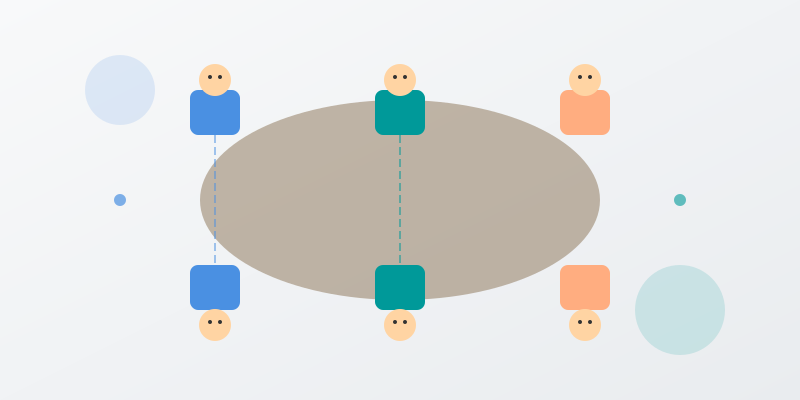
Research by social psychologist Steinzor (1950) showed that people sitting face-to-face converse the most, while those sitting side by side converse the least. Diagonal seating falls in between. Face-to-face positions make eye contact easy and conversation flows naturally. Side-by-side seating makes it harder to meet eyes, reducing opportunities for conversation.
Visualization of Power Dynamics
People sitting at the ends of a long table tend to be perceived as leaders, while center positions convey a neutral impression. Corner seats tend to be seen as lower-status positions. Using a round table diminishes hierarchical perceptions and makes everyone appear equal, naturally fostering fair discussion.
Focus and Motivation
Front seats tend to promote higher concentration and make it easier to speak up, while those in the back tend to relax and become more passive. Window seats are prone to distraction from outside views, whereas center positions create an environment conducive to focus.
Optimal Seating Arrangements by Purpose
Brainstorming (Idea Generation)
The recommended layout is circular or U-shaped.
    [Whiteboard]

  o  o  o  o  o
 o            o
 o            o
  o  o  o  o  o
Everyone is on equal footing, eye contact is easy, and the whiteboard is visible to all. The optimal group size is 6 to 12 people. Rather than using fixed seats, randomized seating that creates fresh combinations each time makes sessions even more effective.
Presentations and Lectures
The recommended layout is theater or classroom style.
[Screen / Lecturer]

 ooooooo
 ooooooo
 ooooooo
 ooooooo
Attention is focused forward and the layout accommodates large groups. However, interaction among participants decreases and concentration tends to drop in the back rows. Creating aisles so the speaker can walk around, deciding the speaking order in advance, and incorporating periodic group work can address these issues.
Group Discussion
The recommended layout is island style.
  ooo      ooo
  ooo      ooo

  ooo      ooo
  ooo      ooo
This arrangement makes it easy to discuss within groups and allows multiple groups to work simultaneously. The optimal group size is 4 to 6 people. See also effective group assignments.
Board Meetings and Decision-Making Meetings
The recommended layout is a rectangular table.
      o
   o     o
   o     o
   o     o
      o
This format maintains the chair's authority while facilitating face-to-face discussion. The downside is that hierarchies become overly visible. Rotating the speaking order or shuffling seats each meeting can help mitigate this.
Networking Events and Social Gatherings
The recommended layout is standing or cafe style.
 [High Table]  [High Table]
     oo           oo
     oo           oo

 [High Table]  [High Table]
     oo           oo
     oo           oo
People can move freely, creating opportunities to talk with a variety of others. Either leaving seating unassigned or assigning seats randomly only at the start can help break fixed relationship patterns. Introducing a shuffle time partway through the event is also effective.
Methods for Deciding Seats
Try Amida-san Free Now
Fixed Seats (Assigned Seating)
Easy to prepare with minimal confusion, and strategic placement is possible. On the other hand, it tends to become stale and limits new interactions. This approach suits formal meetings, situations with clear hierarchies, and events with many first-time attendees.
Free Seating
Respects participant autonomy and creates a relaxed atmosphere. However, people tend to sit in the same spots and cluster with familiar faces. This works best for casual study sessions and small gatherings.
Random Seating
Generates new interactions, ensures high fairness, and prevents staleness. Using a transparent seat assignment tool makes it easy to create arrangements that everyone can accept. Automatically generating different combinations for recurring meetings provides a fresh dynamic each time. This approach is well-suited for team-building training and networking events.
With the Organizer Plan (Pro), you can also attach a seating chart to the participation page as a custom image.
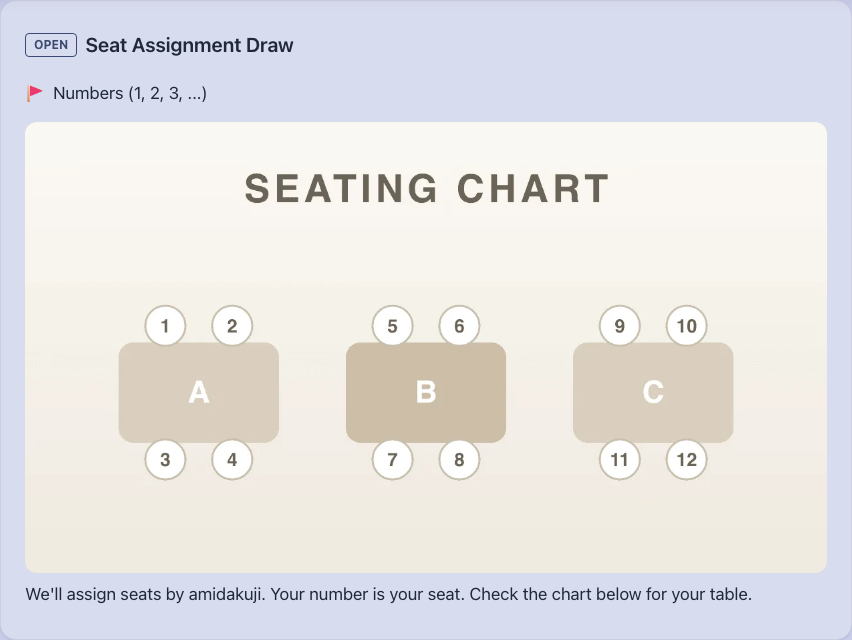
For example, in a 20-person mixer split across 5 tables, the ghost-leg draw hands each guest a table number (1 to 5). With the venue layout placed on the same page, participants just match their number against the chart and walk straight to the right table. There's no need for the host to read seats aloud or hand out paper charts — the draw and the seating guidance live on a single page.
This works well for welcome parties, mixers, and in-session group splits for company training — any setting where you want to assign seats fairly on the spot. See how to decorate your event page for details.
Hybrid (Partially Assigned, Partially Free)
Options include assigning only the front section while leaving the back free, assigning seats only for executives, or assigning groups while allowing free seating within each group. This offers high flexibility but can result in complex rules.
Practical Examples by Scenario
New Employee Orientation
To deepen bonds among new hires, use island-style seating (groups of 5 to 6) and shuffle seats daily. Mix departments and alma maters to create opportunities for everyone to interact. Using a fair grouping tool allows you to design a 3-day training program where everyone ends up in the same group at least once.
Sales Meetings
When the purpose is performance reporting and strategy sharing, a rectangular table with the chair leading the discussion is the standard format. Making the seating completely random to flatten hierarchies is also worth considering. Striking a balance between tension and fairness while ensuring everyone has a chance to speak is key.
Online Meetings (Zoom / Teams)
To create an atmosphere where everyone feels comfortable speaking up, use gallery view to display everyone's faces and breakout rooms for small-group discussions. Deciding the speaking order in advance is also helpful.
Frequently Asked Questions
Q1: What if the same person always ends up in a corner seat?
Introduce random seat assignment. When seats are determined through a transparent method, few people will feel dissatisfied, and every meeting brings the fresh stimulus of a new seat.
Q2: What about people who care about traditional seating etiquette?
In formal settings, this requires attention. Place senior members in positions of honor. For casual settings, announce beforehand that "today we'll use a round table for a flat discussion." Since generational attitudes vary, gathering input in advance is a good idea.
Q3: What about hybrid meetings with both online and offline participants?
Treating online participants as equals is crucial. Display remote attendees on a large screen and ensure equal speaking opportunities. Leveraging chat and polling features makes it easier for them to participate. See also tips for online events.
Summary
Seating arrangement is a critical factor that influences the outcomes of meetings and events. By choosing layout patterns that match the purpose, regularly shuffling seats, and adopting fair and transparent seat assignment, communication quality improves significantly.
To prevent the staleness of fixed seating, a random seat assignment tool is highly effective. Consider reviewing your seating arrangements starting with your next meeting.
Related articles:
Try Amida-san Now!
Experience fair and transparent drawing with our simple and easy-to-use online ladder lottery tool.
Try it Now