
5 Scenarios Where Lotteries Are Needed at Shareholder and Board Meetings [For Public Companies]
Corporate governance refers to the framework through which companies maintain transparent management while protecting the interests of shareholders and other stakeholders. For public companies, this transparency extends to the operations of shareholder meetings and board meetings.
In particular, "proving fairness" and "maintaining records" are indispensable from a legal compliance perspective. Knowing how to ensure transparency in situations that require lotteries -- such as selecting questioners or determining IR session participants -- is part of sound risk management.
This article explains five scenarios in which public companies need lottery processes and how to satisfy both compliance and audit requirements.
This article is intended for general information purposes only and does not constitute legal advice. For legal decisions regarding corporate governance and shareholder meeting operations at public companies, please consult your legal counsel or qualified professionals.

Why Public Companies Need "Transparent Lotteries"
Legal Compliance and Governance
Public companies have obligations under corporate law and securities regulations. They are required to conduct fair shareholder meetings, uphold the principle of equal treatment of shareholders, maintain proper information disclosure and records, and follow transparent decision-making processes. Consult specialists for specific legal details.
Stakeholder Trust
Institutional investors place great importance on governance structures, and transparency is an evaluation criterion from an ESG investment perspective. Audit firms assess the effectiveness of internal controls and verify the reduction of fraud risk. Shareholders expect transparent operations and fair exercise of voting rights.
Reputational Risk
Considering the risks of stock price decline, media coverage, and shareholder derivative lawsuits that could result from unfair operations being uncovered, securing transparency in lottery processes is a reasonable preventive measure.
5 Scenarios Where Lotteries Are Needed
Scenario 1: Questioner Selection at Shareholder Meetings
Q&A sessions at shareholder meetings typically last 30 to 60 minutes, yet the number of shareholders wishing to ask questions can range from 50 to 500. Traditional methods of calling on raised hands or chairman's discretion raise concerns such as "louder shareholders are favored" or "the chairman's selections seem arbitrary."
By having question requesters register in advance, selecting the appropriate number by lottery based on available time, and recording results via URL in the minutes, fairness can be demonstrated. Shareholders who are not selected can receive written responses.
Scenario 2: Appointment of Auditors and Outside Directors (Multiple Qualified Candidates)
When selecting 3 from 5 equally qualified candidates, explaining "why these 3" is not straightforward. Board majority votes or nomination committee recommendations can leave doubts about potential bias.
An approach of listing qualified candidates, conducting a lottery at the board meeting, and recording the results in the minutes enhances the transparency of candidate selection. The final decision remains a formal board resolution.
Scenario 3: Participant Selection for IR and Earnings Briefings
When an IR briefing with a capacity of 100 receives 300 applications, first-come-first-served disadvantages individual investors, while prioritizing institutional investors invites criticism. Excel-based random number selection lacks transparency.
Registering applicants, conducting a lottery, notifying results by email, and offering video recordings to unsuccessful applicants ensures equal treatment of individual and institutional investors, enhancing the credibility of IR activities.
Scenario 4: Shareholder Gift Lotteries
When distributing 100 limited-edition company products among 10,000 shareholders by lottery, traditional computer-based random selection or third-party lottery services tend to be black boxes and can be costly.
A method that publishes results via URL and can demonstrate transparency addresses the concern of "was this really random?" For large numbers, implementation can be split into groups of around 1,000.
Scenario 5: Role Assignment within the Board of Directors
When assigning 10 board members to various committees, appointments by the chairman or CEO or rotation systems can raise concerns about bias or burden concentration on specific individuals. Listing qualified members per committee, determining assignments by lottery, and recording results in the minutes achieves both transparency and fair distribution of responsibilities.
Key Points for Compliance
Try Amida-san Free Now
Record Keeping
Always record the date and time of the lottery, the list of eligible participants, the results, and the lottery method. A system that provides permanent URL-based storage, allows verification at any time, and prevents tampering is ideal.
Audit Response
When auditors ask "Was this lottery fair?", "Are there records?", or "Can a third party verify this?", you can respond with URL verification and the fact that all participants were involved in the lottery process.
Reducing Shareholder Derivative Lawsuit Risk
If a shareholder claims "the lottery was unfair," you cannot prove otherwise without records. A transparent process with permanent URL-based records directly contributes to reducing litigation risk.
Combining Organizer Plan (Pro) Features for Governance
To put "proof of fairness", "record retention", and "audit response" into reliable day-to-day operation, the most efficient path is combining a few features from the Organizer Plan (Pro).
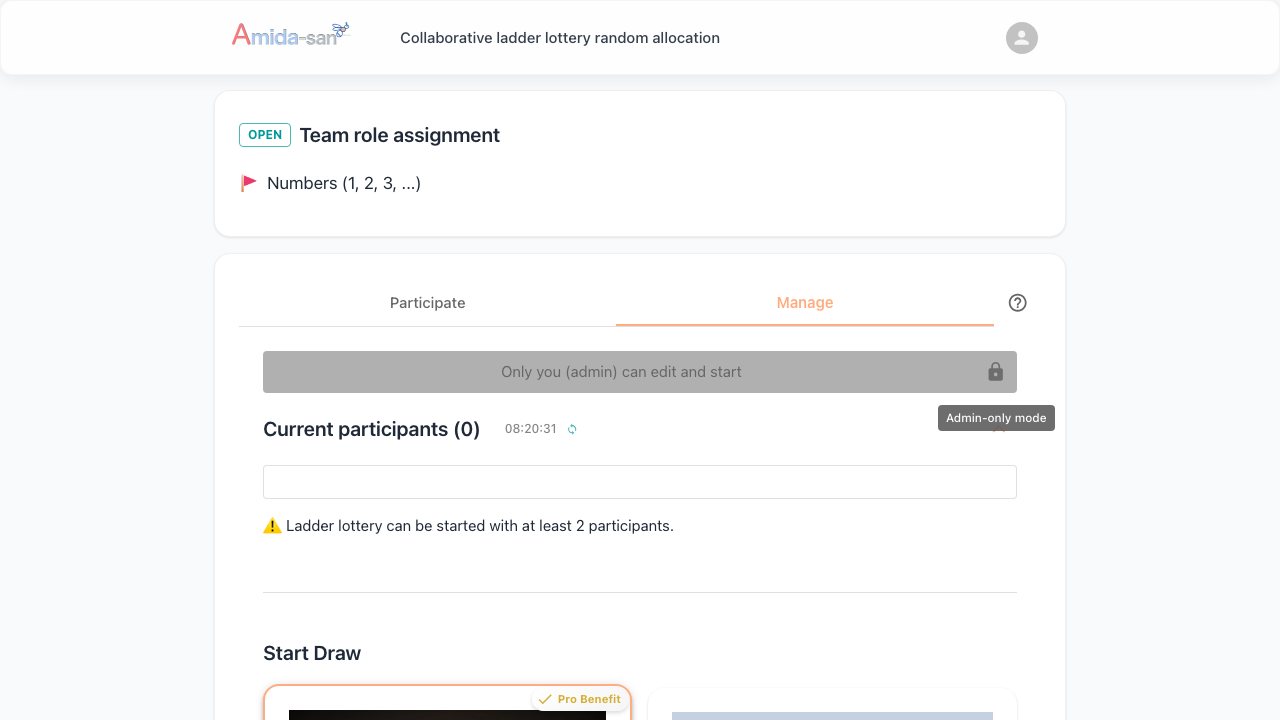
Turning on the organizer-only account lock prevents anyone other than the corporate secretariat from editing or re-drawing the lottery once it is finalized. While the draw URL is on screen at the meeting venue, there is zero risk of an attendee accidentally overwriting the result, and the minutes can note "only the secretariat retained the lock" as part of the audit trail.
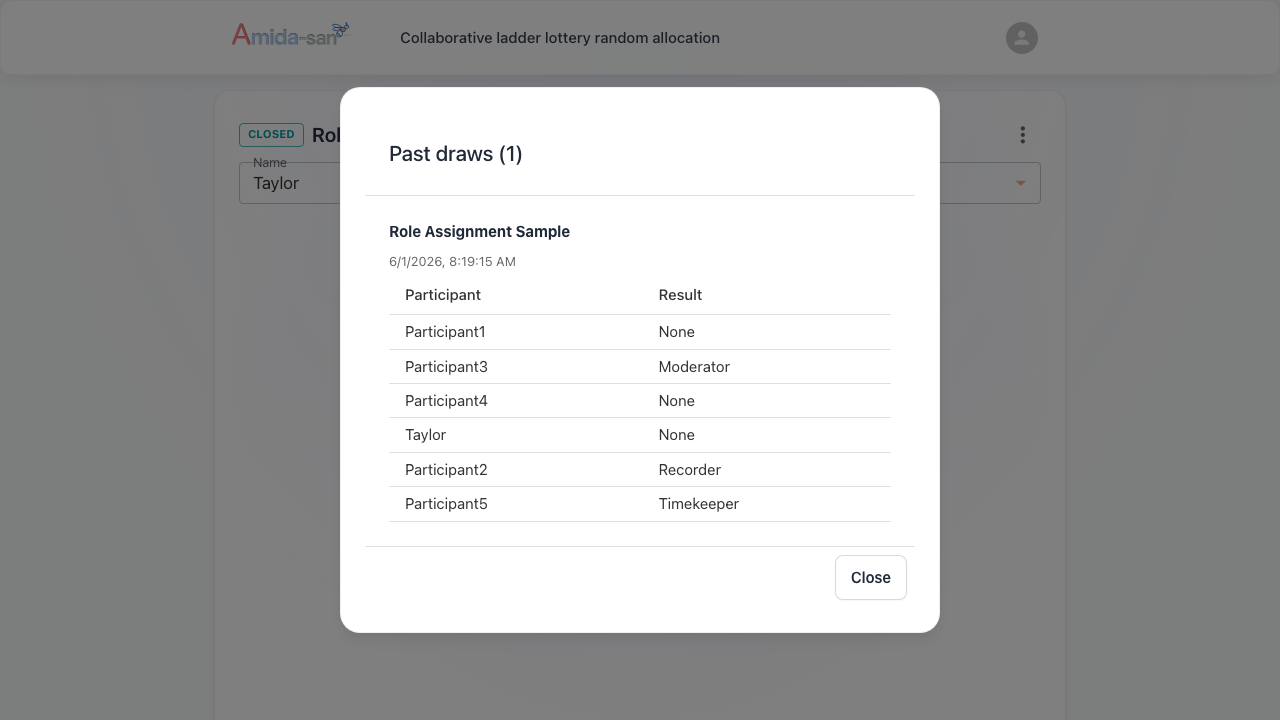
If a questioner withdraws or a registration mistake forces a re-draw, fair re-draws with full history handle it cleanly. The original outcome and the re-drawn outcome both remain as a tamper-proof timeline, so the suspicion that "they redrew to target a specific shareholder" can be answered simply by handing over the history URL.
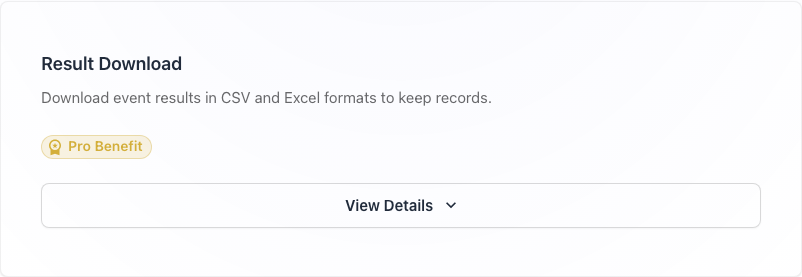
The lottery result itself can be exported with unlimited result downloads into Excel or CSV and attached directly to minutes, audit files, or written notices to shareholders. On top of that, 365-day long-term storage extends record retention so that a single draw URL covers the period from the fiscal year-end annual general meeting through to the audit firm's final report — and any follow-up question that comes in across the fiscal-year boundary can still be answered with the original evidence.
Frequently Asked Questions
Is it acceptable to include URLs in shareholder meeting minutes?
Yes. Noting that "questioner selection was conducted fairly via a digital ghost leg lottery" along with the URL actually serves as proof of transparency and is encouraged.
Do audit firms accept digital tools?
They are accepted as long as the lottery process is fair, records are maintained, and third-party verification is possible.
How do you handle lotteries for large numbers (10,000 people)?
Use a phased approach. For example, divide 10,000 people into 35 groups (approximately 285 each), conduct a lottery within each group, then run a final lottery among the winners to select the final 100.
Conclusion
For public companies, transparent decision-making is the foundation of trust. Lotteries at shareholder and board meetings need to achieve both proof of fairness and maintenance of records. Use permanent URL-based records to prepare for audit responses and litigation, and build stakeholder confidence.
Start by trying questioner selection at your next shareholder meeting, coordinate with your IR and legal departments, and consult your audit firm in advance.
Related articles:
Try Amida-san Now!
Experience fair and transparent drawing with our simple and easy-to-use online ladder lottery tool.
Try it Now