
Interview Order Selection: Fair Methods to Improve Candidate Experience (CX)
Candidate Experience (CX) refers to the overall impression and experience a candidate has from application through the end of the selection process. Among its many factors, interview order is an often-overlooked element that affects both evaluation fairness and CX.
Psychological biases such as the primacy effect (the first candidate leaves a strong impression) and the recency effect (the last candidate leaves a strong impression) unconsciously influence interviewers' evaluations. This article explains fair methods for minimizing the impact of interview order while improving the candidate experience.

How Interview Order Affects Evaluation
Psychological Biases
With the primacy effect, the first candidate leaves a strong impression and becomes the benchmark for comparing later candidates. As a result, evaluations of the second candidate onward tend to be harsher.
With the recency effect, the last candidate's impression remains fresh and vivid. Because the most recent memory is strongest, the last candidate may have an advantage when the evaluation meeting takes place right after interviews.
The contrast effect is also significant. If someone interviews right after an excellent candidate, they tend to be evaluated more harshly, and vice versa. The same person can receive different evaluations depending on who came before them.
Generally, the first and last positions are advantageous, while middle positions are disadvantageous. These biases are difficult for interviewers to completely eliminate even when aware of them, making structural countermeasures necessary.
Four Methods for Fair Interview Order
Method 1: Fully Random (Not Application Order)
Steps:
- List all candidates
- Determine the order by lottery using Amida-san or similar tools
- Notify interview times
This method is completely fair, highly transparent, and easy for candidates to accept. The drawbacks are that it cannot accommodate candidate preferences and scheduling can be complex. However, it is ideal when fairness is the top priority, for mass recruitment of new graduates, or when the number of candidates is large (50 or more). Determining interview times based on application order creates a "first come, first served" dynamic, making randomization important.
Method 2: Preferred Time Slot + Lottery
Steps:
- Ask candidates for their preferred time slot (morning/afternoon)
- Conduct a lottery within each time slot
- Notify results
For example, if 20 people prefer the morning slot (9:00-12:00), use a lottery to determine the order: first at 9:00, second at 9:30, and so on. The afternoon slot (13:00-17:00) is handled the same way. This method accommodates candidate schedules while maintaining fairness within each slot. It also contributes to improved CX, making it well-suited for mid-career recruitment and situations requiring flexibility. Note that there may be evaluation differences between morning and afternoon sessions.
Method 3: Evaluation Sheet + Random Order
Interview order is determined randomly, and absolute evaluation is enforced through evaluation sheets. Evaluations are completed immediately after each interview, and comparing candidates to one another is prohibited.
Example evaluation criteria include communication skills, logical thinking ability, experience and skill fit, motivation and enthusiasm, and cultural fit. Rating each item on a 5-point absolute scale and requiring completion within 5 minutes of each interview minimizes order-related bias.
Rating scale:
- 5: Far exceeds expectations
- 4: Exceeds expectations
- 3: Meets expectations
- 2: Slightly below expectations
- 1: Far below expectations
Comparison with other candidates is prohibited, and evaluations must be completed within 5 minutes of the interview. While this method requires interviewer training, it is the most effective approach for quality-focused evaluations at large companies and for structured interviews.
Method 4: Rotation (For Multiple-Day Schedules)
The first person on Day 1 is placed last on Day 2, and the last person on Day 1 is placed first on Day 2.
For example, if Person A is first and Person J is tenth in the first round of interviews, then in the second round (with 7 candidates advancing), Person J is placed first, Person I second, and Person A last. This offsets advantages and disadvantages over multiple interview rounds, making it fair in the long term. It also provides the benefit of observing candidate growth. While management is more complex, this method is effective for executive-level recruitment and other situations requiring careful selection.
Practical Example: Mid-Career Interviews (30 Candidates)
Preparation (One Week Before)
In Step 1, ask candidates for their preferred time slots. In the scheduling notification, present morning (9:00-12:00) and afternoon (13:00-17:00) options, allow multiple selections, and set a response deadline.
In Step 2, tally the numbers by time slot. For example, 15 prefer morning, 12 prefer afternoon, and 3 have no preference.
In Step 3, conduct a lottery for each time slot using Amida-san. Assign the "no preference" candidates to the less populated slot to finalize the results.
Interview Day
Share the following notes with interviewers in advance:
- Evaluate using absolute criteria; do not compare with other candidates
- Complete the evaluation sheet within 5 minutes of each interview
- Keep evaluation criteria top of mind at all times
- Avoid preconceptions
Conduct 30-minute interviews with 10-minute breaks between them (for completing evaluation sheets). Hold an evaluation meeting after all interviews are complete, discussing results based on evaluation sheets. Interview order should not be a factor.
Notifying Candidates
In the interview schedule notification, include the date, time, and location, along with a note stating: "To ensure fairness, the order was randomly determined within your preferred time slot. We provide equal opportunities to all candidates." Communicating the decision method itself contributes to improved CX. Including contact information for questions also helps put candidates at ease.
Tips for Improving Candidate Experience (CX)
Try Amida-san Free Now
Communicate the Decision Method
Explain to candidates: "To provide fair opportunities for all candidates, our company randomly determines interview order within preferred time slots using a highly transparent lottery tool. We use clearly defined evaluation criteria with absolute evaluation standards to ensure that interview order creates no advantage or disadvantage." This improves candidate satisfaction and demonstrates the company's commitment to transparency.
Be Considerate of Wait Times
For candidates who arrive early, provide a comfortable waiting area (Wi-Fi, power outlets, beverages) and have company materials available. Communicate the estimated wait time and have staff check in periodically.
For candidates in later time slots, maintain the same level of enthusiasm without showing interviewer fatigue. Finish on time and do not let previous interviews run over.
Provide Feedback
Even when a candidate is not selected, you can support their growth by sharing specific points that were evaluated positively and areas for improvement. For example: "Your communication skills met our expectations, but deeper industry knowledge was noted as an area for improvement."
This kind of response can improve the company's image and may even lead to referral recruitment. Candidates who had a positive experience with thorough feedback may recommend the company to their contacts, even after being turned down.
Keep an Audit Trail for Recruitment Records (Pro)
Deciding the order of recruitment interviews is the kind of process that can later be questioned with "didn't the order skew the evaluation?". With the Organizer Plan (Pro), the lottery itself can be treated as an official HR record.
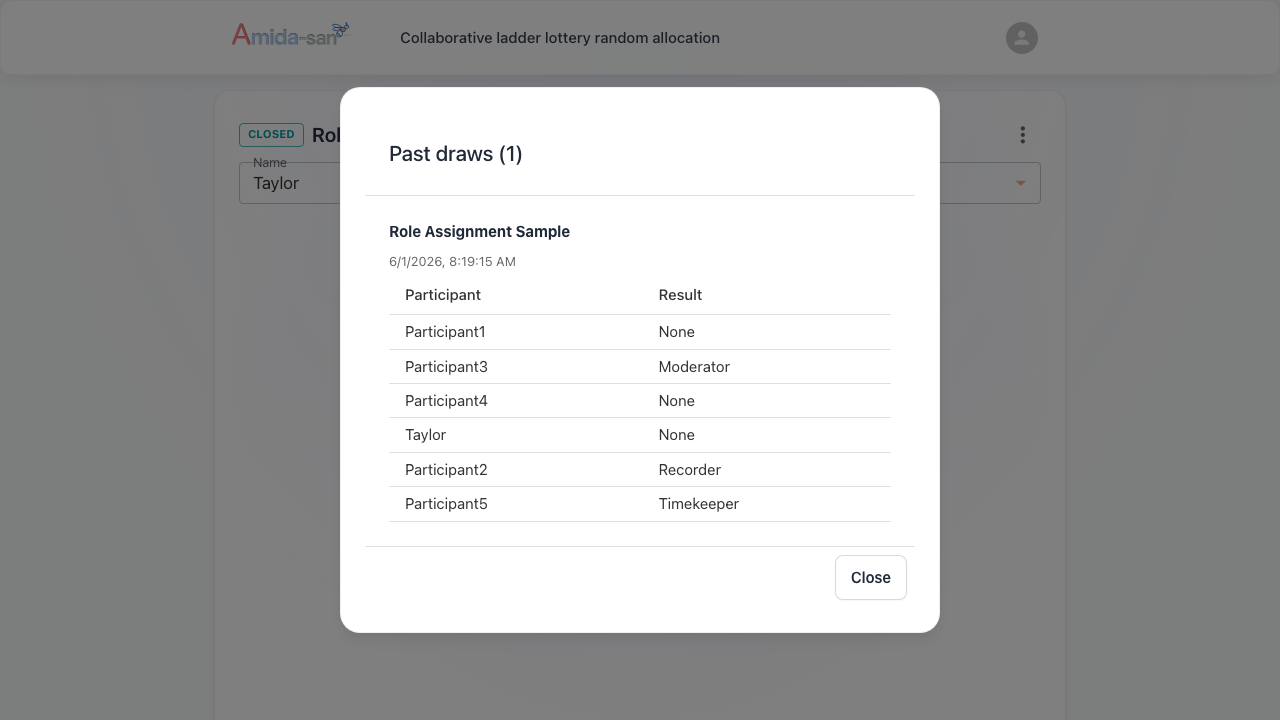
Fair Re-Draws with History lets you redo the order fairly when a candidate withdraws or a schedule changes, while keeping the previous results as a tamper-proof history. The timeline of "this was the initial order, and after a withdrawal we re-drew at this point" stays on record, so you can answer internal audits and inquiries from candidates with the same source of truth.
The drawn order can be exported with Unlimited Result Downloads to Excel or CSV. By keeping the mapping between candidate ID and interview order throughout the recruiting season, you can reuse it as supporting material in evaluation meeting minutes or in offer/rejection notices. Pair it with Extended 365-day storage so the lottery page itself is retained for a year, which is helpful for cross-fiscal-year operations such as new-graduate hiring, where you may want to refer back to last year's lottery URL while planning the next cycle.
When a candidate asks "how was the interview order decided?", you can simply share the lottery URL and let them follow the process from adding horizontal lines to finalizing the result. Showing the real artifact is far more powerful for CX than explaining transparency in text.
Frequently Asked Questions
Q1: Is it not fair to determine order by application date?
Application order creates a "first come, first served" dynamic, disadvantaging those who are slower to gather information. It is also subject to psychological biases, so randomization is fairer.
Q2: How should we address interviewer fatigue?
The following measures are effective:
- Limit the number of interviews per day (around 8 maximum)
- Take a full lunch break (1 hour)
- Rotate among multiple interviewers
- Clarify evaluation criteria to reduce variability in judgment
Q3: Should we disclose the lottery method to candidates?
Disclosure improves transparency and enhances CX. It also reinforces the company's image as conducting fair recruitment.
Q4: Can the same methods be used for online interviews?
Yes, online interviews are actually better suited for these methods. Without travel time, scheduling is more flexible. Sharing the lottery tool URL via chat allows easy participation regardless of location. Tool adoption tends to be smoother in online environments.
Q5: Does this help reduce offer rejections?
The direct effect is limited, but a "fair recruitment process" builds candidate trust. Increased transparency throughout the selection process can indirectly improve offer acceptance rates. Since candidates compare multiple companies when making their final decision, the quality of the selection experience influences their choice.
Summary
Interview order has the potential to influence evaluation outcomes. The five keys to ensuring fairness and improving candidate experience are:
- Determine interview order randomly
- Accommodate preferred time slots to improve CX
- Enforce absolute evaluation through evaluation sheets
- Explain the decision method to candidates
- Adopt mathematically fair methods
Lottery drawing with Amida-san is highly transparent and easy for candidates to accept. Results can be stored and verified via URL for 180 days, and the tool is free and simple to use. Give it a try at your next round of recruitment interviews.
Related articles:
Try Amida-san Now!
Experience fair and transparent drawing with our simple and easy-to-use online ladder lottery tool.
Try it Now